
Prices for Uillean Pipes |
|
* PRACTICE SET |
$2000 |
|
Chanter with reed, brass chanter top, bellows, bag, stocks, blowpipe. |
|
|
|
|
HALF SET |
$4000 |
|
Same as practice set plus tenor, baritone, & bass drones with guill reeds; main stock will accommodate A drone and regulators. |
|
|
|
|
3/4 SET |
$8000 |
|
Same as half set plus tenor & baritone regulators with reeds. |
|
|
|
|
FULL SET |
$10300 |
|
Same as 3/4 set plus standard bass regulator with reed. |
|
|
|
|
DELUXE FULL SET |
$11800 |
|
with fully keyed chanter, wood top with stop-valve, baritone drone with bell and U-bend, "A" drone with separate switch and reed, composite drone reeds. |
|
|
|
|
|
* Practice sets can be made into full sets or any degree between. |
|
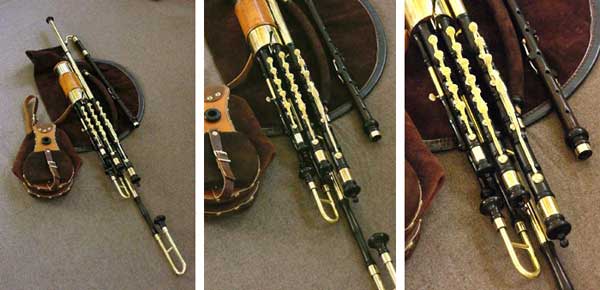
Description My pipes are designed for fullness of tone, stylistic versatility,
aesthetic coherence and ergonomic elegance, incorporating many innovations
based on over thirty-five years of experience as a professional piper and
pipemaker. They are made as I would for myself and are guaranteed against
faulty workmanship. Blackwood is standard for all wooden parts except for
the mainstock and bellows sides, which are cherry. Brass is standard for
all metal parts. All stocks and pipes are reinforced with brass ferrules.
The joints use O-rings instead of thread or cork for a durable snug fit.
The bellows are fitted with leather covered foam pads on both sides and
convenient quick release hook fastened straps. Both the bellows and the
stitched elk hide bag are generously and ergonomically sized for
efficiency and comfort. The main stock is hollowed for increased
resonance. For reasons of conscience I do not use ivory or plastic.
Mountings are simply an extension of the wood of the pipe. Please see Itemized Price List, Options and Explanations and FAQs. Orders are confirmed with a 10% deposit, with a likely waiting time of about two years, although I am not currently taking confirmed orders. Revised 12/21/2012 |
Itemized Price List |
|
|
• Chanter (with block mounts for 4 keys) |
$800 |
|
• Chanter same as above but in C#, C, B, Bb |
$840 |
|
• Chanter Top (brass) |
$110 |
|
• *Chanter Top (wood) |
$250 |
|
• *Stop-valve for Chanter Top (twist style) |
$150 |
|
• *Keys (C, Bb, G#, F) each |
$200 |
|
• Bellows (nailed, leather, with pads and quick release hooks) |
$500 |
|
• Bag (elkhide, sewn, extra large) |
$150 |
|
• *Bag Cover (velvet, for practice set) |
$70 |
|
• *Bag Cover (same as above but will accommodate mainstock) |
$85 |
|
• Stocks (chanter or blowpipe) each |
$60 |
|
• Blowpipe |
$160 |
|
• Tying-in of stocks (per stock) |
$20 |
|
• Mainstock (holes for 4 drones, regulators, and switch keys) |
$420 |
|
• Stock cup |
$100 |
|
• Tenor Drone |
$260 |
|
• Baritone Drone |
$270 |
|
• *Baritone Drone (with bell & U-bend) |
$490 |
|
• Bass Drone (with bell & U-bend) |
$810 |
|
• *"A" Drone (between tenor & baritone) |
$260 |
|
• *Separate switch for "A" drone |
$250 |
|
• Tenor Regulator (has keys for C, B, A, G, F#) |
$2000 |
|
• Baritone Regulator (has keys for A, G, F#, D) |
$1800 |
|
• **Baritone Regulator (with E key between F# and D) |
$2100 |
|
• Bass Regulator (has keys for C, B, A, G) with
detachable, straight reed chamber |
$2100 |
|
• Chanter and Regulator Reeds for pipes made by me |
$120 |
|
• **Chanter and Regulator Reeds for pipes not made by me |
$150 |
|
• Drone Reed (traditional cane guill type) |
$40 |
|
• *Drone Reed (cane tongue, wood body composite type) |
$150 |
|
|
|
**Cases – beautiful dovetailed Mahogany, Ό” foam lined
|
|
|
• 24" x 9" x 4" (will hold up to a 3/4 set) |
$140 |
|
• 28" x 10" x 4" (will hold my full sets) |
$150 |
|
• 30" x 11" x 5" (will hold flat full sets) |
$160 |
|
|
|
|
* Not standard except on deluxe set |
|
Options & Explanations |
(See itemized price list) |
Chanter |
|
Up to four keys can be added for C, Bb, G#, and
F. For those aspiring to versatility, I recommend getting all but the Bb
key, which is rarely used. In my experience, the others are of equal
importance, despite the traditional tendency to prioritize the C key,
which is typically used only for the second octave C natural. For those
wanting to be prepared for anything, the Bb key is available. Any key can
be added at a later date. |
Drones |
|
Traditionally, the uillean pipes have three
drones in octaves of D, or in the case of flat sets, whatever the tonic of
the chanter is. The two smaller drones are “straight out” with the bass
incorporating several U-bends to accommodate its extra length. The last of
these U-bends terminates in an end piece that is sometimes hollowed out
for increased resonance. In the case of my pipes, the end piece is
fashioned as a hollow resonator “bell” and the U-bend incorporates a
“trombone-style” tuning slide for increased tuning versatility. This is
particularly relevant with the extra length of the bass drone and in the
event of using the drones with a flat chanter. All that comes as standard. |
Regulators |
|
Regulators are acoustically like chanters, in that they have conical bores and double reeds, but have permanently closed ends and closed levers (keys) covering the holes, which enables them to remain silent until pressed by the wrist. The keys are aligned in rows so that two or three regulators can be sounded in tandem creating chords to rhythmically and harmonically accompany the melody of the chanter. The limited harmonic options enforce a quirky but charming effect. On traditional sets the baritone regulator notes descend from A to G to F# to D, skipping E. I offer the option of a baritone regulator that includes an E key. The E key does make it a little less convenient to play the G with the D in the traditional way so it’s not for everyone. |
Flat Sets |
|
It is possible to convert a D set of drones and regulators to C# or C. This is done with small adjustments to, or replacement, of the reeds, along with adjustments to the tuning slides. This allows one to economically enjoy the richness of the flat pipes, effectively having two sets for the price of one plus the cost of the flat chanter. Sets can also be made to span C to B or Bb with different chanters. |
|
|
| Back to main page |